

At three weeks postpartum, I was feeding a baby girl, fueling up on Dr Pepper, and scoring all the best Black Friday deals for her closet.
Dressing my kids is my Olympic sport. If you see us out and about, they’ll likely be matching. I’m savoring the chance to keep them coordinated as long as I get to make the executive decisions.
But a day will come when my son doesn’t need mama to lay out his church clothes. And I’ll rue the day if my girl ever decides that tulle is too girly…
Then, we’ll have bigger challenges than deciding, “Will she wear the bubble romper or ruffled dress today?” As my children grow, I’m praying for the wisdom to teach them how to present themselves with modesty.
It’s an idea that’s old-fashioned and, dare I say, out of style. Some say things like, “It’s my body, I’ll dress how I want.” Or, “Modesty is about the heart, not actually about what I wear.”
I’ve even heard women argue that modesty is forced upon women in response to our hyper-sexualized culture. Kelley Werner says this in her article for Christians for Biblical Equality[1]:
“Modesty has a problem…I must honor men by covering my body so they don’t fall into sin…these “rules” are impossible and destructive. They were created by men for men’s benefit…We need to fight against a culture that sexualizes and commercializes women’s bodies. But we also need to fight against the response culture in our churches that shames and hides them…”
Kelley claims that modesty has been forced upon women by men who don’t want to correct their own faults. It makes me wonder: have we overemphasized the importance of modesty? Have we forced women to follow manmade rules? Is modesty really about how we dress or is it actually about the heart, like Kelley and others say?
A Professional’s Opinion on Modesty
Carlie Palmer-Webb gave her opinion on the topic. She has a Master’s degree in “Marriage, Family and Human Development with an emphasis in Healthy Sexuality.” She uses her degree to provide “shame-free sex ed for Christians in every life stage[2].” With over 141,000 followers on her Instagram, @thechristiansexeducator, many women trust her advice.
On the topic of modesty, Carlie wrote this:
“We can help our children and youth to develop the trait of modesty by teaching them to dress 1) for the activities of that day and 2) in a way that makes them feel comfortable and allows them to focus outward[3].”
In another post, she shares four questions to help parents and children to pick swimsuits together:
“Can you do everything you want to do in this swimsuit without worry or needing to constantly adjust?…
Do you feel comfortable in this swimsuit?…
Will this swimsuit help you focus on others and the experience that you’re having or make it more difficult?
Are you willing to put sunscreen everywhere that isn’t covered?[4]”
What bothers me about Carlie Palmer-Webb’s and Kelley Werner’s stances is that neither appeal to God’s Scriptures as an authority. They’re simply statements of opinions.
Therein lies the struggle for women. We constantly hear opinions from popular, seemingly credible sources. They remind us that modesty is barely referenced in the New Testament, and claim that modesty has been pushed upon women in a way that God never intended.
After all, we’re made in His image. Why should we be ashamed of the bodies He gave us?
Here’s what I know: God would not give us a boundary that isn’t good for us.
So the real questions are, what’s God’s plan for modesty? What does the Bible say about modesty? Does modesty matter for Christian women today?
In this article, we’ll search the scriptures for answers to those questions.

What Does the Bible Say About Modesty?
Before we can know if modesty matters for women today, we have to understand what modesty is.
Modesty is just about as old as humanity. The Bible says that God created Adam and Eve and placed them in the Garden of Eden. Before sinning, Adam and Eve were innocent and unashamed to be naked (Genesis 2:25).
But after their sin, their awareness changed. They were suddenly aware of their nakedness and felt ashamed (Genesis 3:7, 10). They tried to make coverings for themselves, but God created more sufficient clothing (Genesis 3:21).
Proper attire remains important to God throughout the Old Testament. In Exodus 28, God gives detailed instructions for how the holy priests should be clothed:
“Make linen undergarments to cover their bare flesh, extending from waist to thigh. Aaron and his sons must wear them whenever they enter the Tent of Meeting or approach the altar to minister in the Holy Place, so that they will not incur guilt and die. This is to be a permanent statute for Aaron and his descendants.” —Exodus 28:42-43
God took modesty so seriously that failure to follow His instructions brought guilt and the threat of death. To avoid such guilt, the priests would wear these undergarments as part of their dress. Their nakedness would not be exposed, and nobody would be distracted during worship times.
The New Testament has little to say about how we should dress, compared to other topics. But the New Testament isn’t silent on the subject.
Paul writes this to Timothy:
“I desire then that in every place the men should pray, lifting holy hands without anger or quarreling; likewise also that women should adorn themselves in respectable apparel, with modesty and self-control, not with braided hair and gold or pearls or costly attire, but with what is proper for women who profess godliness—with good works.” —1 Timothy 2:8-10
Paul teaches that women should adorn themselves—or “put themselves in order”—with proper apparel. The guidelines for that apparel should be modesty (reverence or shame, like Adam and Eve experienced) and self-control (“self-restraint, sobriety, and soundness of mind”).
To put simply, there should be an appropriateness of dress based on the setting.
A prom dress is no more appropriate for a walk in the park than pajamas would be for worship. A woman should not be drawing attention to herself with what she wears. Her appearance should be like a mirror reflecting the spirit of Christ to others. Gaudy dress stands in the way of this. Gaudiness is not godliness.
Peter writes this:
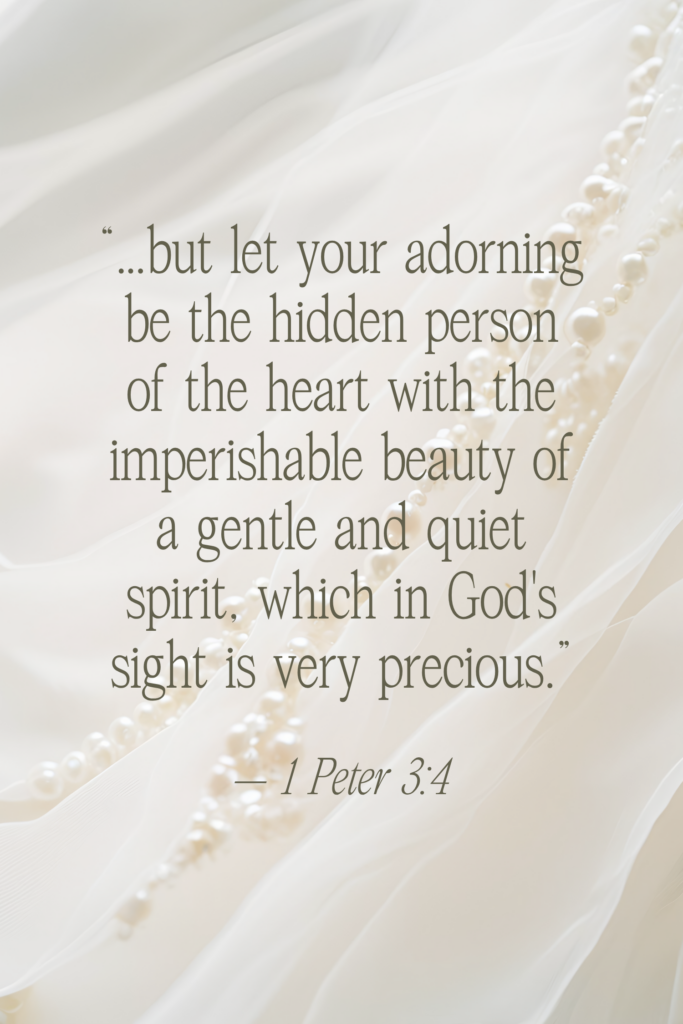
“Likewise, wives, be subject to your own husbands, so that even if some do not obey the word, they may be won without a word by the conduct of their wives, when they see your respectful and pure conduct. Do not let your adorning be external—the braiding of hair and the putting on of gold jewelry, or the clothing you wear—but let your adorning be the hidden person of the heart with the imperishable beauty of a gentle and quiet spirit, which in God’s sight is very precious. For this is how the holy women who hoped in God used to adorn themselves…” —1 Peter 3:1-5
He’s expressing that a wife’s primary goal should be her inward presentation. He urges wives with unbelieving husbands to show the example of Christ through “pure conduct, reverence, calm spirit, and inner beauty instead of outward show.[5]”
Notice something missing from both these New Testament scriptures: an actual description of how high necklines should be or how long hemlines should be. And perhaps this is why many women feel comfortable exposing their bodies while saying, “No, no! God looks at the heart, not the hemline!”
After all, Peter does say that beauty comes from the inner disposition of the heart. So then the next question is, what should the inner disposition of a Christian woman’s heart be?
What Does the Bible Say About the Heart and Modesty?
I have seen—on multiple occasions—bikini-clad (or barely-clad) women post their photos online, claiming that because God made their beautiful bodies and their hearts love Him, that means even a bikini at the beach can be modest.
I’ve seen women deny the truth that their bodies are tempting and deflect blame solely to men for not controlling their lust. But consider these scriptures.
The Lord warns that our hearts can be deceitful (Jeremiah 17:9). We can’t trust our feelings to determine right from wrong. We must follow the direction of Proverbs 3.
“Trust in the LORD with all your heart, and do not lean on your own understanding. In all your ways acknowledge him, and he will make straight your paths.” —Proverbs 3:5-6
After sinning with Bathsheba, the psalmist and king David wrote this:
“Behold, you delight in truth in the inward being, and you teach me wisdom in the secret heart. Purge me with hyssop, and I shall be clean; wash me, and I shall be whiter than snow…Create in me a clean heart, O God, and renew a right spirit within me.” —Psalm 51:6-7, 10
The Hebrew word translated “clean” means “to be pure,” and the word translated “right” could also be “established, set, or steadfast.” David longs for his heart to be pure and established in God’s wisdom.
Remember that Paul tells us to “present our bodies as a living sacrifice, holy and acceptable to God” (Romans 12:1). And he says in 1 Corinthians:
“Flee from sexual immorality. Every other sin a person commits is outside the body, but the sexually immoral person sins against his own body. Or do you not know that your body is a temple of the Holy Spirit within you, whom you have from God? You are not your own, for you were bought with a price. So glorify God in your body.” —1 Corinthians 6:18-20
Examining the scriptures sets us straight. Our hearts should be pure, steadfast, and dependent on God for clarity. Our bodies should be holy, set apart, used for His glory, and far away from sexual immorality.
Is Modesty an Over-Correction from Purity Culture?
Even after examining the scriptures, some still see modesty as an extreme response to “purity culture.” They say if men didn’t over-sexualize us, we wouldn’t have to cover up. They say women shouldn’t bear the blame for men’s lust.
I sympathize with women who feel this way. It’s valid to say that every man is responsible, like David, to seek God’s heart-cleansing.
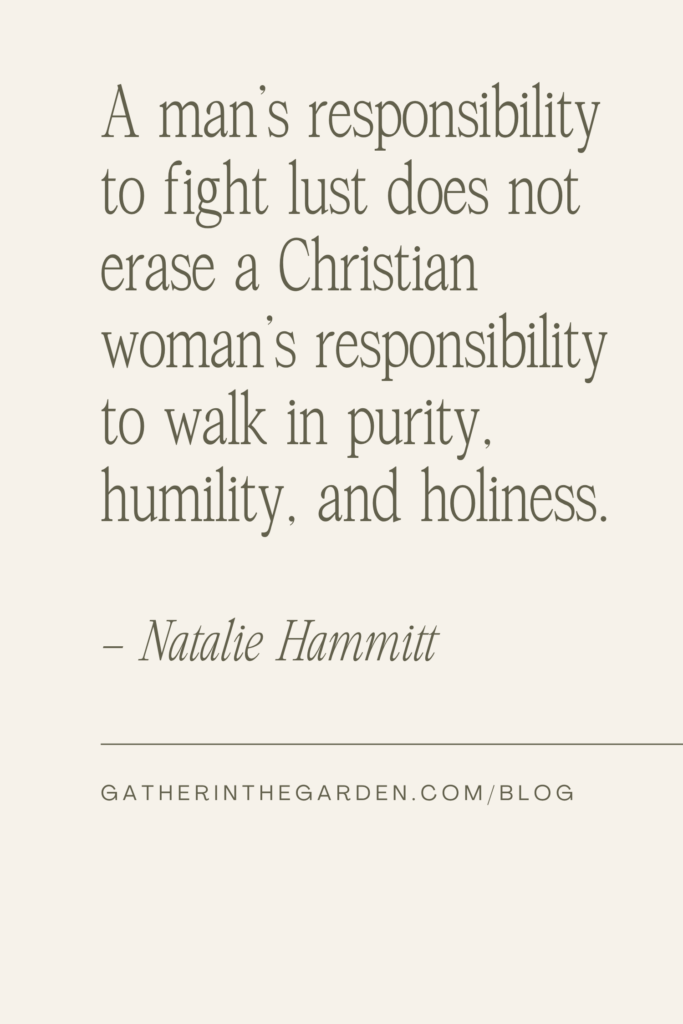
But a man’s responsibility to fight lust does not erase a Christian woman’s responsibility to walk in purity, humility, and holiness.
Paul gives us an obligation to avoid being a “stumbling block” to others (1 Corinthians 8:9). And he warns us: if we wound the conscience of the weak, then we have sinned against Christ (1 Corinthians 8:12).
Christians should help other Christians pursue holiness.
Our Christian brothers are called to holiness, too, yet they live in a culture bombarded with immodesty. How can we, in good conscience, present our bodies in a sexual, uncovered, shameful way and ask—no, expect—our Christian brothers to remain untouched by the devil’s temptations?
To say, “my body is not a temptation” when we dress in a tempting way is a denial of reality. To say, “I’ve been over-sexualized” while actively presenting ourselves in sexually suggestive clothing is a denial of responsibility.
Who can see your gentle, quiet spirit if we are flaunting external beauty? If for no other reason, we choose to dress modestly to protect our Christian family from stumbling, wouldn’t our Father be pleased?
Biblical Modesty Still Matters Today
Modesty isn’t a new idea. It’s not a manmade construct. It’s God’s standard for His people.
Yes, modesty comes with sacrifice. The hunt for clothing might be harder. We may not wear the pieces that a personal stylist claims are the most flattering for our figure. But we’re aiming to accentuate Christ’s spirit living within us, not our curvy exterior.
Modesty may be out of style. But God’s standard never goes out of style.
His wisdom and instruction perfectly apply to every time period, every culture. When a woman dresses modestly because of faithfulness to the Lord, she offers herself as a pleasing fragrance to her Holy Creator (2 Corinthians 2:15).
One day, my little girl won’t be so little anymore. She’ll stand in front of the mirror without asking for my input. When that day comes, I pray she’ll be comfortable in the body God designed for her. But even more so, I pray she’ll understand that modesty isn’t a set of rules forced upon her. It’s about presenting herself with holiness and humility for the Lord who gave her beauty.
And now, it’s your turn to weigh in. Tell me in the comments, would you dress modestly if you knew it would help your Christian brothers pursue holiness?
Sources
[1]: The Problem With Modesty by Kelley Werner
[2]: The Christian Sex Educator
[3]: The Christian Sex Educator on Instagram example A
[4]: The Christian Sex Educator on Instagram example B
[5]: Overview of 1 Peter 3 on Bible Hub
Be the first to comment